import numpy as np
from sklearn.datasets import make_blobs
from matplotlib.patches import Patch
from sklearn.metrics import confusion_matrix
from sklearn.metrics import classification_report
import pandas as pd
from sklearn.preprocessing import LabelEncoder
from matplotlib.patches import Patch
import matplotlib.pyplot as plt
from itertools import combinations
from sklearn.linear_model import LogisticRegression
le = LabelEncoder()

# for plotting decision region
from sklearn.decomposition import PCA
from sklearn.svm import SVC
from mlxtend.plotting import plot_decision_regions

from sklearn.preprocessing import PolynomialFeatures
from sklearn.pipeline import Pipeline
from sklearn.model_selection import cross_val_score


class supp_vec_machine():
    def __init__(self, row_length=3, C=10, b=0.0001) -> None:
        self.C = C
        self.b = b
        self.row_length = row_length
        self.weights = np.random.randn(self.row_length)
        self.weights_old = np.random.randn(self.row_length)
        self.beta = None


    def fit(self, X, y, max_iter=1e3, alpha=0.1, tol=1e-6, lamb=1.5):
        '''
        We pad X once right after calling regress
        '''
        i = 0
        j = 1
        X = self.patek(X)
        n = X.shape[0]
        p = X.shape[1]
        self.weights = self.weights.reshape(-1,1)
        term = self.C * (X.T @ y)
        term = term.reshape(-1,1)
        y = y.reshape(-1,1)
        converged = False
        lamb = lamb

        while j < max_iter and not converged:
            y_row = y.reshape(1, -1)
            # dot_prod = y_row @ self.y_hat(X)
            # print(f"dot_prod: {dot_prod}")
            # dLdy_dydw = (1*(dot_prod<1)) * (y @ np.sum(X, axis = 0))
            # term = np.sum(dLdy_dydw* X, axis = 0)
            # term = term.reshape(-1,1)
            # print(f"term: {term}")
            dLdy_dydw = 0
            for i in range(n):
                yy_hat = y[i,0] * self.y_hat(X)[i,0]
                dLdy_dydw = dLdy_dydw + (1*(yy_hat <1)) * (y[i,0]) * (X[i, :].reshape(-1,1))

            term = dLdy_dydw/n
            term = term.reshape(-1,1)
            # print(f"term: {term}")
            nabla_weight = lamb * self.weights - term
            # y_hat = self.y_hat(X)
            # y_hat = y_hat.reshape(-1,1)
            nabla_weight = nabla_weight.reshape(-1,1)
            # print("nabla_weight 2")
            # print(nabla_weight.shape)
            alpha = 1 / (lamb * j)
            # update self.weights
            self.weights = self.weights - alpha*(nabla_weight)
            # nabla_b =  -y * self.b
            # nabla_b = np.where(1-y_hat<=0, 0, nabla_b)
            # nabla_b = sum(nabla_b)
            # self.b = -nabla_b * alpha / n
            if j % 500 == 0:
                print(f"iter_count: {j}")
            j = j + 1
            if not np.any(np.abs(self.weights_old- self.weights)>tol):
                converged = True
                print(f"Converged with {j} iterations")
                print(f"The weights we end up with is: {self.weights}")
            self.weights_old = self.weights
        self.beta = self.weights


    def y_hat(self, X):
        '''
        y_hat = W^T * X + b
        b is the bias term
        '''
        # self.b = self.b.reshape(-1,1)
        self.weights = self.weights.reshape(-1,1)
        # y_hat = (X @ self.weights) + self.b
        y_hat = (X @ self.weights)
        # y_hat = np.dot(X,self.weights) + self.b
        y_hat = y_hat.reshape(-1,1)
        return y_hat


    def hinge_loss(self,y,y_hat):
        ''' xi = max(1- y*y_hat, 0) '''
        y = y.reshape(-1)
        y_hat = y_hat.reshape(-1)
        xi = 1 - y * y_hat
        return np.where(xi<0, 0, xi)

    def loss_function(self, xi: np.array) -> np.array:
        '''
        should we devide by length?
        '''
        self.weights = self.weights.reshape(-1,1)
        wTw = self.weights.T @ self.weights
        HingeLossSum = self.C * np.sum(xi)
        return wTw + HingeLossSum

    def nabla_weight(self, term):
        '''
        this is the gradient
        Loss, aka Labrangian
        nabla Loss = w - sum C * y_i * x_i
        '''
        self.weights = self.weights.reshape(-1,1)
        nabla = self.weights - term
        return nabla

    def patek(self, X: np.array) -> np.array:
        '''
        Certified pre-owned bust-down patek function for padding
        '''
        return np.append(X, np.ones((X.shape[0],1)), 1)


    def regress(self, X, y, max_iter=1e3, alpha=0.1, tol=1e-8):
        '''
        We pad X once right after calling regress
        '''
        i = 0
        X = self.patek(X)
        n = X.shape[0]
        p = X.shape[1]
        self.weights = self.weights.reshape(-1,1)
        term = self.C * (X.T @ y)
        term = term.reshape(-1,1)
        y = y.reshape(-1,1)
        converged = False

        while i < max_iter and not converged:
            nabla_weight = self.nabla_weight(term)
            y_hat = self.y_hat(X)
            # y_hat = y_hat.reshape(-1,1)
            nabla_weights = np.zeros((p,n))
            for w in range(self.weights.shape[0]):
                # print(w)
                # print(nabla_weight)
                # nabla_weight[w] = np.where(np.any(1-y_hat<=0), self.weights[w], nabla_weight[w])
                dummy = np.where((1 - y_hat)<=0, self.weights[w], nabla_weight[w])
                dummy = dummy.reshape(-1)
                nabla_weights[w] = dummy
                # print("nabla_weight 1")
                # print(nabla_weight.shape)
            nabla_weight = np.sum(nabla_weights, axis=1)
            # print(nabla_weight)
            nabla_weight = nabla_weight.reshape(-1,1)
            # print("nabla_weight 2")
            # print(nabla_weight.shape)

            # update self.weights
            self.weights = self.weights - alpha*(nabla_weight/n)
            nabla_b =  -y * self.b
            nabla_b = np.where(1-y_hat<=0, 0, nabla_b)
            nabla_b = sum(nabla_b)
            self.b = -nabla_b * alpha / n
            if i % 10 == 0:
                print(f"iter_count: {i}")
            i = i + 1
            if not np.any(np.abs(self.weights_old- self.weights)>tol):
                converged = True
                print(f"Converged with {i} iterations")
                print(f"The weights we end up with is: {self.weights}")
            self.weights_old = self.weights
        self.beta = self.weights

    def predict(self, X):
        X = self.patek(X)
        innerProd = X @ self.beta
        y_hat = 1 * (innerProd > 0)
        return y_hat


    def score(self,X,y):
        y = y.reshape(-1)
        mypredict = self.predict(X)
        mypredict = mypredict.reshape(-1)
        myscore = 1 * (mypredict == y)
        return myscore.mean()


    def bare_bone_plot(self, X: np.array, y: np.array, size_1: int, size_2: int) -> None:
        plt.rcParams["figure.figsize"] = (size_1,size_2)
        mypredict = self.predict(X)
        # score = (mypredict == y).mean()
        print(f"the weight beta is: {self.beta}")
        a_0 = self.beta[0][0]
        a_1 = self.beta[1][0]
        a_2 = self.beta[2][0]
        fig = plt.scatter(X[:,0], X[:,1], c = y)
        xlab = plt.xlabel("Feature 1")
        ylab = plt.ylabel("Feature 2")
        f1 = np.linspace(-7.5, 7.5, 501)
        p = plt.plot(f1,  -(a_2/a_1) - (a_0/a_1)*f1, color = "black")
        # title = plt.gca().set_title(f"score is: {round(score,3)}")
        title = plt.gca().set_title("our regression")

    def helper_plot(self, X, y, subplot, label):
        '''
        Helper method for big_plot
        '''
        score = self.score(X,y)
        a_0 = self.beta[0][0]
        a_1 = self.beta[1][0]
        a_2 = self.beta[2][0]
        fig = subplot.scatter(X[:,0], X[:,1], c = y)
        subplot.set(xlabel="Feature 1", ylabel="Feature 2", title=f"score: {round(score, 3)} using {label} data")
        # the line
        f1 = np.linspace(-1, 3, 501)
        # p = subplot.plot(f1,  -(a_2/a_1) - (a_0/a_1)*f1, color = "black")
        p = subplot.plot(f1,  +(a_2/a_1) - (a_0/a_1)*f1, color = "black")


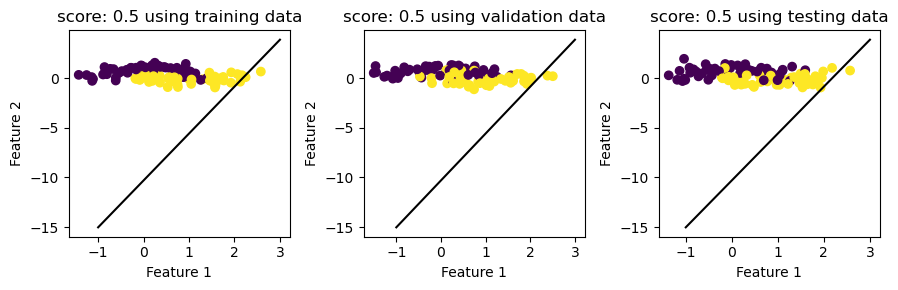
    def big_plot(self, X_train, y_train, X_validate, y_validate, X_test, y_test, size_1, size_2):
        plt.rcParams["figure.figsize"] = (size_1,size_2)
        fig, axarr = plt.subplots(1,3)
        self.helper_plot(X_train, y_train, axarr[0], "training")
        self.helper_plot(X_validate, y_validate, axarr[1], "validation")
        self.helper_plot(X_test, y_test, axarr[2], "testing")
        plt.tight_layout()